

Link Building in 2026: What Actually Works, What's Dead, and What Most Guides Won't Tell You


Most link building guides tell you the same thing: "Get high-quality backlinks from relevant sites."
Thanks. Very helpful.
Here's the problem: that advice hasn't changed since 2015. But link building has. Google has. AI search has. And if you're still following the playbook from five years ago, you're wasting time and money on tactics that barely move the needle.
This guide is different. I'll tell you exactly:
What's actually working right now (with data)
What's quietly dying (that most people still do)
What's overrated vs. underrated
And a framework for deciding which links are worth chasing
Let's cut through the noise.
The TL;DR: Link Building Still Matters (But Differently)
Before we dive deep, here's the reality check:
Yes, backlinks still matter. Pages ranking #1 on Google have 3.8x more backlinks than pages ranking #2-10. That correlation hasn't weakened.
But the game has changed:
What Worked Before | What Works Now |
Quantity of links | Quality + relevance of links |
Any DR 50+ site | Topically relevant DR 40+ sites |
Exact-match anchor text | Natural, varied anchors |
Guest post farms | Digital PR + genuine editorial links |
Links only | Links + brand mentions (for AI visibility) |
The biggest shift? AI search engines now matter. ChatGPT, Perplexity, and Google's AI Overviews pull from top-ranking pages ~75% of the time. So ranking still matters for AI visibility. But brand mentions may matter even more for getting cited directly.
That's why the smartest SEOs in 2026 aren't just building links — they're building linkable brands.
What Link Building Actually Is (30-Second Version)
Link building is getting other websites to link to yours.
That's it.
When Site A links to Site B, Google interprets it as a vote of confidence. More votes (especially from trusted sources) = higher rankings.
The original Google algorithm, PageRank, was literally built on this concept. And while the algorithm has evolved dramatically, the core principle remains: links signal trust.
Now let's talk about what actually matters in 2026.
The Link Value Framework™: How to Evaluate Any Backlink in 10 Seconds
Here's the problem with most link building advice: it treats all "high-quality" links the same.
They're not.
A DR 60 link from a random tech blog is not equal to a DR 45 link from a niche-specific site that your target audience actually reads.
After analyzing thousands of link building campaigns, I've developed a simple framework for evaluating backlink quality:
The Link Value Framework™
Link Value = Authority × Relevance × Traffic Potential
Factor | Weight | What to Look For |
Authority | 30% | DR/DA 40+, clean backlink profile, real site (not a link farm) |
Relevance | 50% | Same niche, same audience, contextually appropriate |
Traffic Potential | 20% | Real organic traffic, potential for referral clicks |
Why relevance is weighted highest:
Google's algorithm has gotten extremely good at understanding topical relationships. A link from a DR 40 SEO blog to your SEO tool is worth more than a link from a DR 70 lifestyle magazine that has nothing to do with your niche.
I've seen sites gain zero ranking benefit from "high authority" links that were completely off-topic. And I've seen massive jumps from mid-authority links that were perfectly relevant.
How to use this framework:
Score each opportunity from 1-10 on each factor, then multiply:
Authority (1-10) × 0.3
Relevance (1-10) × 0.5
Traffic (1-10) × 0.2
Example:
Opportunity | Authority | Relevance | Traffic | Score |
DR 70 lifestyle blog | 9 | 2 | 7 | (9×0.3)+(2×0.5)+(7×0.2) = 5.1 |
DR 45 SEO niche blog | 6 | 9 | 5 | (6×0.3)+(9×0.5)+(5×0.2) = 7.3 |
The niche blog wins — even though it has lower authority.
Stop chasing DR. Start chasing relevance.
What's Actually Working in 2026 (Ranked)
Based on industry data and real campaign results, here's what's moving the needle right now:
1. Digital PR (Most Effective — But Hardest)
Effectiveness: 10/10 Difficulty: 9/10 Best for: Established brands, companies with newsworthy stories/data
48.6% of SEO professionals now rate digital PR as their most effective link building tactic. It's overtaken guest posting for good reason:
Links come from high-authority news sites (DR 70-90+)
They're genuinely editorial (Google loves this)
You also get brand mentions (critical for AI visibility)
When to use it:
You have original data or research to share
You can create genuinely newsworthy angles
You have budget for PR outreach or agency support
When to skip it:
You're a new site with no brand recognition
You don't have resources for content creation
Your niche isn't newsworthy
My take: Digital PR is the future of link building. But it's not accessible to everyone. If you can't do it well, don't do it poorly — you'll just waste money.
2. Link Insertions / Niche Edits (Underrated)
Effectiveness: 8/10 Difficulty: 6/10 Best for: Sites with existing content worth linking to
Link insertions — getting your link added to existing, ranking content — are quietly one of the most effective tactics right now.
Why? The page already has authority. It's already ranking. Your link gets immediate contextual value.
When to use it:
You have genuinely useful resources to link to
You can find relevant existing articles that would benefit from your link
You're willing to offer value (not just ask for favors)
When to skip it:
Your content isn't actually useful
You're approaching random sites with no relevance
You're trying to buy insertions on spammy sites
My take: This is underrated because it's less glamorous than "getting featured in Forbes." But for pure ranking impact per dollar spent, it's often better.
3. Strategic Guest Posting (Still Works — With Caveats)
Effectiveness: 7/10 Difficulty: 7/10 Best for: Building topical authority, reaching new audiences
Guest posting isn't dead. But guest posting on garbage sites is dead.
The problem: 85.3% of sites on guest post marketplaces are low quality (DR <40, <10K traffic). Most of what's easily available is worthless.
When to use it:
You can get on legitimate, relevant sites that your audience reads
You're writing genuinely valuable content (not thinly-veiled link bait)
The site has real traffic and engagement
When to skip it:
The site accepts anyone (red flag)
DR is below 30 with no real traffic
The site is clearly a "guest post farm" with no editorial standards
My take: I'd rather have 5 guest posts on real niche sites than 50 on pay-to-play blogs. Quality has never mattered more.
4. Broken Link Building (Solid, Not Spectacular)
Effectiveness: 6/10 Difficulty: 5/10 Best for: Sites with existing resources that could replace dead links
The idea is simple: find broken links on relevant sites, create content that could replace them, offer it as a replacement.
It works because you're solving a problem for the site owner.
When to use it:
You have (or can create) content that genuinely replaces the dead resource
You're targeting relevant sites in your niche
When to skip it:
You're mass-emailing about broken links with no real replacement value
The broken links are on irrelevant sites
My take: It's a solid B-tier tactic. Not exciting, but reliable. Good for supplementing other strategies.
5. Creating Linkable Assets (Long-Term Play)
Effectiveness: 9/10 (over time) Difficulty: 8/10 Best for: Sites playing the long game
Original research, free tools, comprehensive guides, and data studies naturally attract links over time.
This isn't "outreach" — it's building something worth linking to and letting links come to you.
When to use it:
You can invest in creating genuinely unique resources
You're thinking 6-12+ months ahead
You have expertise or data others don't
When to skip it:
You need quick results (this takes time)
You can't create anything meaningfully different from what exists
My take: This is the most sustainable approach. But it requires patience and genuine investment. Most people give up too early.
What's Quietly Dying (Stop Wasting Time on These)
Let's be blunt about what's not worth your time anymore:
❌ Mass Guest Posting on Low-Quality Sites
If a site accepts guest posts from anyone, those links are nearly worthless. Google has gotten very good at identifying and devaluing these link farms.
The math doesn't work: Even at $50-100 per post, you need dozens of low-quality links to equal one good link. And the risk of penalty is real.
❌ Directory Submissions (Mostly)
General directories are useless. Niche-specific directories with editorial standards can still provide minor value, but they're not moving rankings.
Exception: Industry-specific directories with real traffic and credibility (like ProductHunt for SaaS) still matter.
❌ Comment/Forum Link Spam
This hasn't worked for a decade, yet people still do it. Stop.
❌ PBNs (Private Blog Networks)
Yes, some people still use them. Yes, some still see short-term results. But Google's detection has improved dramatically. The risk/reward no longer makes sense.
❌ Reciprocal Link Exchanges
"I'll link to you if you link to me" is obvious to Google. A few natural reciprocal links are fine, but systematic exchanges are devalued.
The Real Costs in 2026 (What No One Tells You)
Let's talk money, because most guides conveniently skip this.
What Links Actually Cost
Link Quality | Typical Cost | Notes |
Low (DR 20-40) | $100-$200 | Barely worth it in most cases |
Medium (DR 40-50) | $200-$400 | Minimum threshold for real impact |
High (DR 50-60) | $400-$700 | Sweet spot for most campaigns |
Top Tier (DR 60+) | $700-$3,000+ | Often requires relationships or PR |
Digital PR cost per link: ~$750 average (but highly variable)
Agency retainers: $5,000-$15,000+/month for quality work
The Hidden Cost: Time
If you're doing link building in-house, factor in:
10-20 hours/week for research, outreach, follow-ups
SEO tool subscriptions ($100-400/month)
Content creation time (if doing guest posts)
My take: Link building is either expensive in money or expensive in time. There's no cheap, easy path to quality links. Anyone selling that is lying.
Who Should Prioritize What (Decision Framework)
Different situations call for different strategies. Here's my honest recommendation:
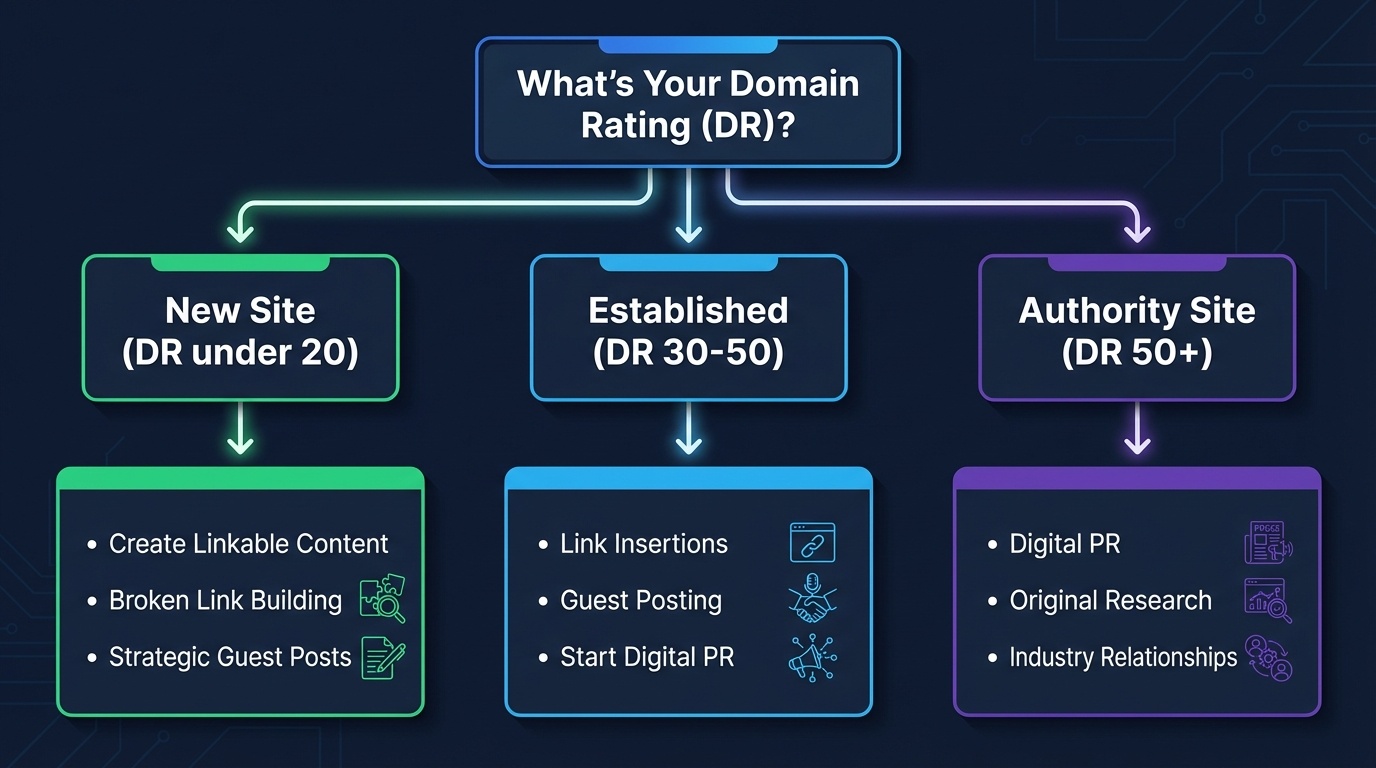
If You're a New Site (DR <20)
Prioritize:
Creating 2-3 genuinely linkable content pieces
Broken link building to relevant sites
A few strategic guest posts on real niche sites
Skip:
Digital PR (you don't have the brand recognition yet)
Expensive link placements (ROI won't be there)
Mass outreach (focus on quality over quantity)
Timeline to results: 6-12 months
If You're an Established Site (DR 30-50)
Prioritize:
Link insertions on relevant, existing content
Strategic guest posting on authority sites
Starting to invest in digital PR angles
Skip:
Low-quality guest post farms
Generic directory submissions
Timeline to results: 3-6 months
If You're an Authority Site (DR 50+)
Prioritize:
Digital PR and thought leadership
Original research and data studies
Building genuine industry relationships
Skip:
Anything that looks spammy or low-quality
Tactics that could risk your reputation
Timeline to results: 1-3 months for incremental gains
Link Building for AI Search: The New Frontier
Here's what most guides miss: AI search is changing the game.
ChatGPT, Perplexity, Google AI Overviews — these don't just look at rankings. They look at brand mentions and citations across the web.
Recent research found that brand mentions correlate more strongly with AI visibility than backlinks alone.
What this means for you:
Links still matter — AI pulls from top-ranking pages ~75% of the time
Brand mentions matter too — even unlinked mentions influence AI citations
Digital PR is doubly valuable — it builds both links AND brand mentions
This is why "link building" is evolving into something broader: building a linkable, citable brand.
How to Get Started (Without Overwhelm)
If you're new to link building, here's the exact sequence I'd follow:
Week 1-2: Audit
Check your current backlinks (Ahrefs, Semrush, or free tools)
Identify your best content (what's actually worth linking to?)
Find 20-30 relevant sites in your niche
Week 3-4: Low-Hanging Fruit
Find unlinked brand mentions (ask for links)
Identify broken link opportunities
Look at competitor backlinks for ideas
Month 2-3: Active Outreach
Start personalized outreach for link insertions
Pitch 2-3 quality guest posts
Begin building relationships with niche site owners
Month 4+: Scale What Works
Double down on winning tactics
Consider investing in digital PR
Create linkable assets for passive link acquisition
Key Takeaways
Let me leave you with the honest truth about link building in 2026:
Links still matter — but relevance now beats raw authority
Quality over quantity — 5 great links > 50 mediocre links
Digital PR is the future — if you can do it, prioritize it
Guest posting isn't dead — but guest post farms are
Use the Link Value Framework™ — Authority × Relevance × Traffic
AI search changes things — brand mentions matter alongside links
There's no cheap shortcut — invest time or money, but invest properly
Expect 3-6 months — link building is a long-term play
The sites winning at link building in 2026 aren't chasing links. They're building brands worth linking to, creating content worth citing, and playing a longer game than their competitors.
That's the real strategy.
Put the Link Value Framework™ into practice. LinkIntel automatically scores backlink opportunities by Authority, Relevance, and Traffic—so you know exactly which links are worth pursuing.
Share this article
About Abdulla Abdurazzoqov
Abdulla Abdurazzoqov is a serial SaaS builder who has been creating and ranking products through organic search since 2019. He has scaled multiple SEO-driven projects to six-figure MRR and successfully sold websites, focusing on link building systems, outreach automation, and AI-powered SEO workflows.