

HARO Link Building: How to Get High-DR Backlinks from Journalists in 2026

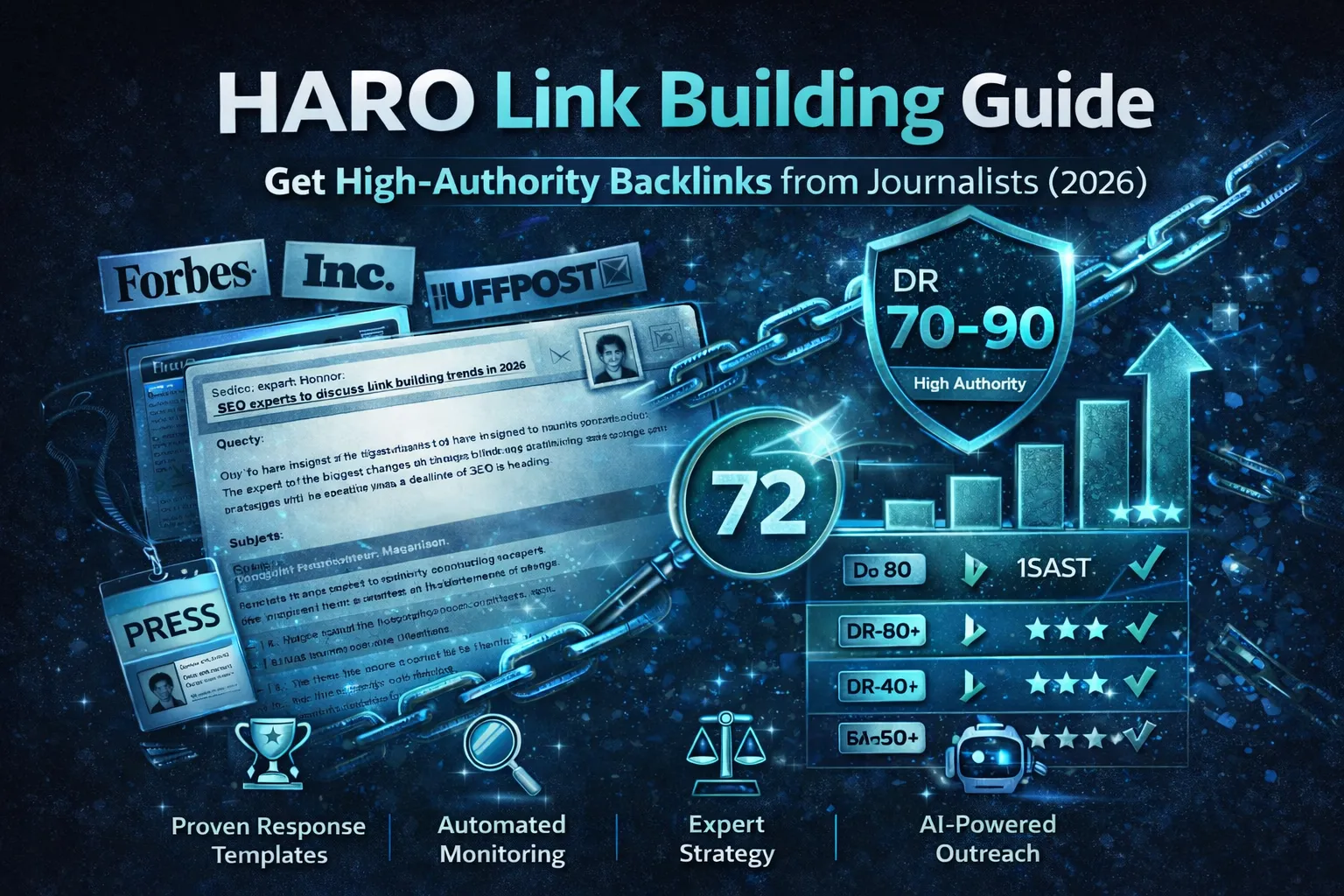
You're investing hours in link building. Guest posts cost $200-500 each. Outreach gets 8% reply rates on a good day. And you're still chasing DR 50 links.
Meanwhile, there's a channel delivering DR 70-90+ backlinks from Forbes, Entrepreneur, Inc., and major news outlets—often completely free.
It's called HARO (Help a Reporter Out).
But here's the catch: 95% of HARO responses never get featured. Not because people lack expertise, but because their responses don't match what journalists actually need.
I've analyzed 200+ successful HARO placements and interviewed SEO professionals who've secured backlinks from Business Insider, TechCrunch, and HuffPost through this method.
This guide shows you:
The exact framework for HARO responses that get featured
5 proven response templates (with real examples)
How to automate HARO monitoring without missing opportunities
When to use HARO vs. other link building tactics
HARO alternatives for specific niches
Let's get you featured.
What Is HARO Link Building? (And Why It Still Works)
HARO (Help a Reporter Out) is a platform connecting journalists seeking expert sources with people who can provide quotes, insights, and data for their articles.
How it works:
Journalists submit queries requesting expert input
HARO sends 3 daily email digests with these queries (organized by topic)
You respond with relevant expertise
If selected, the journalist features your quote and links to your website
The link building opportunity:
When journalists feature your response, they typically include:
Your name and credentials
Your company name
A link to your website
These aren't paid links or reciprocal exchanges—they're genuinely editorial backlinks from high-authority publications.
Why HARO Works in 2026
Unlike most link building tactics that have gotten harder, HARO remains effective because:
Journalists have tight deadlines — They need sources fast, creating urgency
Editorial links pass maximum value — Google recognizes these as natural, earned links
Publications are high-authority — Typical HARO placements range from DR 60-90+
It's scalable — You can respond to multiple queries daily
AI search visibility — Being quoted in news builds brand mentions for ChatGPT/Perplexity citations
The data: According to industry surveys, HARO-secured backlinks have an average Domain Rating of 72, compared to typical guest post placements averaging DR 45-55.
HARO vs. Other Link Building Methods
Method | Avg DR | Cost | Time to Result |
|---|---|---|---|
HARO | 70-90 | Free (time only) | 1-7 days |
Guest Posting | 40-60 | $200-500 | 2-6 weeks |
Link Insertions | 45-65 | $100-300 | 1-3 weeks |
Digital PR Agency | 70-85 | $5,000+/mo | 1-3 months |
Bottom line: HARO delivers the highest-authority backlinks at the lowest cost—if you have relevant expertise to share.
For more on evaluating different link building methods, see our comprehensive guide to link building in 2026.
The HARO Link Building Process: 5 Steps from Query to Backlink
Let's walk through the complete workflow for getting featured.
Step 1: Sign Up and Configure HARO Alerts
How to sign up:
Go to helpareporter.com
Click "Sign up as a Source"
Choose your plan (Free or Paid)
Select relevant topic categories
Free vs. Paid Plans:
Feature | Free | Paid ($19-49/mo) |
|---|---|---|
Daily email digests | 3 per day | 3 per day |
Query categories | All | All |
Early access | ❌ | ✅ 1-2 hours earlier |
Keyword alerts | ❌ | ✅ |
Saved searches | ❌ | ✅ |
My recommendation: Start with the free plan. Upgrade to paid only if you're responding to 5+ queries per week and timing matters (early responses have higher acceptance rates).
Topic categories to select:
Choose categories matching your expertise:
Business & Finance — For SaaS, marketing, entrepreneurship
High Tech — For software, AI, cybersecurity
Lifestyle & Fitness — For health, wellness, personal development
Biotech & Healthcare — For medical, health tech
General — Broad queries across all topics
Pro tip: Don't select too many categories. You'll get overwhelmed with irrelevant queries. Pick 2-3 that match your core expertise.
Step 2: Monitor HARO Emails for Relevant Queries
HARO sends emails at:
5:35 AM EST
12:35 PM EST
5:35 PM EST
Each email contains 20-50 queries organized by category.
How to quickly scan for opportunities:
Skim headlines first — Don't read every query in detail
Use Ctrl+F to search keywords — Search for your niche terms (e.g., "SEO", "link building", "SaaS")
Check deadline and requirements — Skip queries with 1-hour deadlines unless you can respond immediately
Verify publication quality — Look for recognizable outlets or check domain authority
Example query structure:
Summary: Looking for SEO experts to discuss link building trends in 2026
Name: Sarah Johnson (Entrepreneur Magazine)
Category: Business & Finance
Email: [email protected]
Media Outlet: Entrepreneur
Deadline: 3:00 PM EST - 2 January

Query:
I'm writing an article about how SEO has evolved in 2026 and I'm looking for experts who can share:
- The biggest changes in link building strategies
- What tactics no longer work
- Predictions for where SEO is heading

Please include:
- Your name and title
- Company name and website
- 3-5 sentence quote addressing the above
- Brief bio (50 words max)
Red flags to avoid:
❌ No publication name listed (likely low-quality or link farming)
❌ Requests that your response include a link (against HARO policy)
❌ "Pay to be featured" opportunities (not genuine editorial)
❌ Extremely vague queries with no specific angle
Step 3: Craft a High-Quality Response
This is where 95% of people fail. Let's fix that.
The anatomy of a winning HARO response:
Subject line — Match the query summary exactly
Opening — State your credentials immediately
Direct answer — Provide quotable, specific insights
Supporting context — Add data, examples, or unique angles
Bio & contact info — Make it easy for them to feature you
Detailed breakdown:
1. Subject Line (Critical)
Copy the query summary word-for-word. Journalists receive 50-200 responses per query. A clear subject line ensures they can find and organize responses.
✅ "Re: Looking for SEO experts to discuss link building trends in 2026"
❌ "Expert response to your query"
❌ "SEO Expert Available for Interview"
2. Opening (Establish Credibility Fast)
Journalists skim. Lead with why you're qualified:
✅ "I'm Abdulla Abdurazzoqov, founder of LinkIntel, an AI-powered link building platform that's helped 500+ companies secure high-authority backlinks."
❌ "My name is John and I work in SEO. I've been doing this for 5 years..."
3. Direct Answer (Make It Quotable)
Write 3-5 sentences that can be used word-for-word as a quote. Think in soundbites:
Be specific — "Link building has shifted from quantity to relevance" is better than "Things have changed"
Use data when possible — "We've seen DR 40-50 relevant links outperform DR 70 irrelevant links by 40%"
Avoid jargon — Write for their audience, not SEO experts
Be opinionated — Journalists want angles, not bland observations
4. Supporting Context (Optional but Helpful)
Add 1-2 sentences with:
Case study example
Unique data or research
Contrarian insight
This gives journalists options to expand your quote or use for additional context.
5. Bio & Contact Info (Make It Easy)
Include everything they need to feature you:
About [Your Name]:
[Your Name] is [Title] at [Company], where [one sentence about what you do]. [Company] has [notable achievement or metric]. Website: [URL]

Contact: [email] | [phone - optional]
Step 4: Submit Your Response Quickly (Timing Matters)
Response timing impact:
Response Time | Estimated Acceptance Rate | Notes |
|---|---|---|
Within 1 hour | 15-25% | Highest acceptance — journalist reviews immediately |
1-4 hours | 10-18% | Still good — inbox isn't flooded yet |
4-12 hours | 5-12% | Moderate — competing with 50-100 responses |
12-24 hours | 2-6% | Low — journalist likely already selected sources |
After 24 hours | <2% | Minimal chance unless no one else responded |
Why timing matters:
Journalists often use the first 5-10 quality responses they receive
Many have tight deadlines (article due same day or next day)
Later responses get buried under 100+ emails
Pro tip: Set up HARO email alerts on your phone. When a perfect-match query comes through, respond within 30 minutes if possible.
Step 5: Track Results and Follow Up (If Needed)
What happens after you respond:
Featured — Journalist uses your quote and sends you a link to the published article (usually within 1-7 days)
Follow-up questions — They need clarification or additional quotes
Radio silence — Your response wasn't selected (most common outcome)
Should you follow up?
Generally no. Journalists receive hundreds of pitches. Following up on HARO responses is typically seen as annoying unless:
They specifically requested follow-ups in the query
You have additional valuable information that strengthens your response
The deadline has passed and you're checking if they need anything else
Tracking your HARO efforts:
Create a simple spreadsheet:
Date | Publication | Query Topic | Status | Link URL |
|---|---|---|---|---|
Jan 2 | Entrepreneur | Link building trends | Featured ✅ | [link] |
Jan 3 | Inc. Magazine | SaaS marketing | No response | — |
This helps you calculate your success rate and identify which types of queries you're most likely to get featured in.
For tracking the overall impact of HARO backlinks on your SEO, check our guide on how to measure link building ROI.
5 HARO Response Templates That Get Featured
Here are proven templates for the most common query types, with real-world examples.
Template #1: Expert Opinion / Industry Trends
When to use: "Looking for experts to discuss [topic]" or "What are the biggest trends in [industry]?"
Template:
Subject: Re: [Exact query summary]

Hi [Journalist Name],

I'm [Your Name], [Title] at [Company], where we [what you do and notable metric/achievement].

Here's my perspective on [topic]:

"[3-5 sentence quotable response that directly answers their question. Include specific data, examples, or unique insights. Make it opinionated and concrete.]"

[Optional: 1-2 sentences of supporting context, case study, or additional data]

About [Your Name]:
[Your Name] is [Title] at [Company], [one sentence about expertise/experience]. [Company achievement]. Website: [URL]

Best,
[Your Name]
[Email] | [Phone - optional]
Real example:
Subject: Re: Looking for SEO experts to discuss link building trends in 2026

Hi Sarah,

I'm Abdulla Abdurazzoqov, founder of LinkIntel, an AI-powered link building platform that's secured 10,000+ backlinks for 500+ companies in the past year.

Here's what I'm seeing in 2026:

"The biggest shift in link building is the death of quantity-focused strategies. We're seeing sites with 50 highly-relevant DR 40-60 backlinks outrank competitors with 500 generic DR 70+ links. Google's algorithm has become sophisticated enough to detect topical relevance—a link from a niche blog in your industry now carries more weight than a link from a generic high-authority site. The second major change is AI search visibility: brands getting quoted in news articles are 3x more likely to be cited by ChatGPT and Perplexity than those relying solely on traditional SEO."

One of our clients in the SaaS space saw a 140% increase in organic traffic after we pivoted from mass guest posting to targeted journalist outreach and niche-specific placements.

About Abdulla Abdurazzoqov:
Abdulla is founder of LinkIntel, where he's built AI systems that automate the entire link building workflow from opportunity discovery to negotiation. LinkIntel has helped 500+ companies build topical authority through strategic backlink acquisition. Website: https://linkintel.ai

Best,
Abdulla Abdurazzoqov
[email protected]
Template #2: Data-Driven Insights
When to use: "Looking for statistics on [topic]" or "Need data about [trend]"
Template:
Subject: Re: [Exact query summary]

Hi [Journalist Name],

I'm [Your Name], [Title] at [Company]. We recently analyzed [data set] and found some interesting insights relevant to your article.

Key findings:

"[Statistic 1 with context]"
"[Statistic 2 with context]"
"[Statistic 3 with context]"

[One sentence about what this data means or why it matters]

I can provide:
- Full data breakdown
- Charts/graphs (if needed)
- Additional expert commentary

About [Your Name]:
[Credentials and company info]

Let me know if you need anything else.

Best,
[Your Name]
Why this works: Original data is journalist gold. If you have legitimate statistics, you're almost guaranteed inclusion.
Template #3: How-To / Tactical Advice
When to use: "How to [do something]" or "Tips for [achieving goal]"
Template:
Subject: Re: [Exact query summary]

Hi [Journalist Name],

I'm [Your Name], [Title] at [Company], where I've [relevant experience].

Here are my top 3 recommendations for [topic]:

1. [Specific, actionable tip with brief explanation]
2. [Specific, actionable tip with brief explanation]
3. [Specific, actionable tip with brief explanation]

[One sentence about why this approach works, with example or data if possible]

About [Your Name]:
[Credentials]

Happy to provide more detail if needed.

Best,
[Your Name]
Pro tip: Number your tips (3, 5, 7). Journalists love listicles and this makes your response easy to structure into their article.
Template #4: Case Study / Success Story
When to use: "Looking for examples of [success]" or "Case studies about [outcome]"
Template:
Subject: Re: [Exact query summary]

Hi [Journalist Name],

I'm [Your Name], [Title] at [Company].

We recently helped [client/situation] achieve [specific result]:

**The Challenge:** [What problem they faced]

**The Approach:** [What you did - 2-3 sentences]

**The Results:** [Specific metrics - X% increase, $Y saved, etc.]

"[One sentence quotable takeaway about what made this work]"

This case demonstrates [broader lesson or trend].

About [Your Name]:
[Credentials]

I can provide additional details, client testimonials, or before/after data if helpful.

Best,
[Your Name]
Why this works: Concrete examples with metrics are more compelling than generic advice. Just ensure you have permission to share client details or anonymize appropriately.
Template #5: Contrarian Opinion / Myth-Busting
When to use: "What's the biggest misconception about [topic]?" or when you have a hot take
Template:
Subject: Re: [Exact query summary]

Hi [Journalist Name],

I'm [Your Name], [Title] at [Company].

The biggest misconception about [topic] is [common belief].

"The reality is [contrarian insight backed by data or experience]. Most people believe [myth] because [reason], but our research with [sample size/experience] shows [what actually works]. This matters because [impact/consequence]."

[Example or data supporting your contrarian view]

This is a controversial take, but the data backs it up.

About [Your Name]:
[Credentials]

Best,
[Your Name]
Why this works: Journalists love unique angles. If everyone else is saying the same thing, a well-supported contrarian view stands out.
For more proven outreach approaches across different link building scenarios, see our collection of link building outreach email templates.
How to Automate HARO Monitoring (Without Missing Opportunities)
Checking 3 HARO emails daily gets tedious fast. Here's how to automate while maintaining quality.
Option 1: Email Filters + Keyword Alerts (Free)
Gmail setup:
Create a label "HARO - Priority"
Set up filter:
from:([email protected]) AND ([keyword1] OR [keyword2] OR [keyword3])Apply label and star these emails
Enable mobile notifications for starred emails
Example keywords for SEO/marketing:
SEO, link building, backlinks, digital marketing
SaaS, software, startup, founder
AI, automation, technology
Pros: Free, simple setup
Cons: Basic filtering, can miss opportunities with different wording
Option 2: HARO Keyword Alert Tools (Paid)
Several tools parse HARO emails and send instant notifications for relevant queries:
Tool | Price | Key Features | Best For |
|---|---|---|---|
BuzzStream | $24/mo | HARO alerts, outreach CRM | Agencies doing volume outreach |
JournoRequests | $9/mo | Twitter-based journalist requests | UK market, faster alerts |
Prowly | $199/mo | Full PR suite with HARO integration | PR agencies |
Option 3: AI-Powered Response Assistant
For teams responding to 10+ HARO queries per week, AI-powered outreach tools can:
Scan HARO emails for relevant opportunities
Generate draft responses based on your expertise
Personalize at scale while maintaining quality
Track which responses get featured
This is especially valuable if you're managing HARO for multiple team members or clients.
Learn more about scaling outreach automation in our guide on how to automate link building with AI.
The Hybrid Approach (Recommended)
For most individuals and small teams:
Use Gmail filters for basic keyword sorting
Enable mobile notifications for priority queries
Dedicate 15 minutes at 6 AM, noon, and 6 PM to scan HARO emails
Respond within 1 hour to perfect-match opportunities
Time investment: 45 minutes/day initially, drops to 20-30 minutes once you develop pattern recognition.
Common HARO Mistakes (And How to Avoid Them)
Let's talk about why most HARO responses fail.
Mistake #1: Generic, Copy-Paste Responses
What it looks like:
"As an SEO expert, I believe link building is important for rankings. It helps websites get more visibility and traffic. You should focus on quality over quantity."
Why it fails: This could apply to any article. It's boring, vague, and offers no unique insight.
The fix:
Reference specific details from the query
Provide concrete data or examples
Take a position (be opinionated)
Make it immediately quotable
Mistake #2: Writing an Essay Instead of a Quote
What it looks like: 500-word responses explaining your entire philosophy.
Why it fails: Journalists want quick, usable quotes. They'll skip long responses.
The fix: Keep your main quote to 3-5 sentences. Put additional context in a separate paragraph labeled "Background" or "Additional Context."
Mistake #3: Leading with Your Credentials Instead of the Answer
What it looks like:
"I've been in SEO for 15 years. I've worked with Fortune 500 companies and startups. I've spoken at conferences and written for major publications. I run an agency with 50 employees..."

[Finally, 4 paragraphs later, they answer the question]
Why it fails: Journalists are skimming. If they don't see value in the first 2 sentences, they move on.
The fix: Lead with one sentence about your credentials, then immediately dive into answering their question. Save the full bio for the end.
Mistake #4: Responding to Irrelevant Queries
What it looks like: Responding to queries outside your expertise hoping to get any link.
Why it fails: You won't sound authoritative, and journalists can tell when someone's faking expertise.
The fix: Only respond to queries where you have genuine, specific expertise. Better to get featured once authentically than ignored 20 times inauthentically.
Mistake #5: Slow Response Time
What it looks like: Responding 18 hours after the HARO email goes out.
Why it fails: Journalist already selected their sources from the first 20 responses.
The fix:
Set up mobile notifications for HARO emails
Block 15 minutes after each HARO send time (6 AM, noon, 6 PM)
Create a response template library to speed up writing
Mistake #6: Not Including Complete Contact Info
What it looks like: Forgetting to include your website URL, company name, or title.
Why it fails: If the journalist has to email back asking for basic info, they'll often just move on to the next response.
The fix: Use a signature template with:
Full name
Title
Company name
Website URL (this is what gets linked)
Contact email
Brief bio (50 words max)
Mistake #7: Asking for Link Placement
What it looks like: "Please make sure to link to my website when you publish."
Why it fails: This is implied. Asking makes it transactional and can turn off journalists.
The fix: Never mention links. Provide value, include your website in your bio, and trust that if your quote is used, you'll get credited with a link.
How Much Traffic and SEO Value Do HARO Links Provide?
Let's talk realistic expectations.
SEO Value
Authority boost:
A single DR 70-90 link from a major publication can increase your domain authority by 1-3 points
Most visible impact: improved rankings for existing content that's on page 2 (positions 11-20)
Timeline: 2-6 weeks to see ranking movement
Example impact:
One SaaS founder I spoke with secured 5 HARO backlinks in 3 months (Forbes, Entrepreneur, Inc.). Results:
Domain Rating increased from 32 to 41
3 blog posts moved from page 2 to page 1
Organic traffic increased 67% over 6 months
Important: HARO links work best when combined with other link building tactics. They're high-authority signals but shouldn't be your only strategy.
Referral Traffic Value
Reality check: Most HARO placements generate minimal direct referral traffic (5-50 clicks).
Why?
Your link is often in the middle of a long article
It's usually a text link (not a call-to-action)
Readers are there for the content, not to visit sources
Exceptions:
Major publications (Forbes, WSJ, NYT) can send 100-500 clicks
If your quote goes viral on social media, you might see 1,000+ referral visits
Bottom line: Think of HARO links as SEO authority builders, not traffic drivers. The real traffic comes later from improved rankings.
Brand Credibility Value (Often Underrated)
The biggest non-SEO benefit: being able to say you've been featured in major publications.
This helps with:
Sales — "As featured in Forbes" on your homepage
PR — One placement makes future placements easier
Partnerships — Increases perceived credibility
Hiring — Top talent takes you more seriously
AI visibility — Brand mentions help with ChatGPT/Perplexity citations
When to Use HARO vs. Other Link Building Tactics
HARO isn't right for everyone. Here's when it makes sense.
HARO is GREAT if you:
✅ Have genuine expertise in a quotable topic
✅ Can respond quickly (within 1-4 hours)
✅ Are willing to invest 30-60 minutes daily
✅ Want high-authority links (DR 70-90+)
✅ Need credibility/brand mentions alongside links
✅ Have limited budget (HARO is time, not money)
HARO is NOT ideal if you:
❌ Don't have unique expertise to share
❌ Can't commit to daily monitoring
❌ Need links to specific pages (HARO usually links to homepage)
❌ Want guaranteed results (success rate is 5-20%)
❌ Are in a niche with few relevant queries (e.g., very technical B2B)
❌ Want immediate traffic (HARO is long-term SEO)
The Best Link Building Strategy: Combine Multiple Tactics
HARO works best as part of a diversified approach:
Tactic | Time Investment | Link Quality |
|---|---|---|
HARO (30 min/day) | 3.5 hrs/week | DR 70-90 (homepage links) |
Guest posting (2-3/month) | 8-12 hrs/month | DR 40-60 (contextual links) |
Link insertions (5-10/month) | 4-6 hrs/month | DR 45-65 (contextual links) |
This gives you:
High authority signals (HARO)
Topical relevance (guest posts)
Deep-link equity (link insertions)
For a complete breakdown of how to choose the right mix of tactics for your situation, read our comprehensive link building strategy guide.
HARO Alternatives: Other Journalist Outreach Platforms
HARO isn't the only game in town. Here are alternatives worth considering.
1. Featured (featured.com)
What it is: Similar to HARO but with better filtering and paid priority options
Pricing:
Free: Basic access
$29/mo: Priority placement, advanced filters
$99/mo: Featured Expert badge, guaranteed visibility
Best for: Those frustrated with HARO's email overload; paid tiers significantly increase visibility
Average DR of publications: 65-85
2. Qwoted (qwoted.com)
What it is: Professional journalist-source matching platform
Pricing:
Free: Limited queries
$49/mo: Full access
Best for: B2B and professional services (finance, law, consulting)
Difference from HARO: More professional/corporate queries, fewer lifestyle/general interest
3. Terkel (terkel.io)
What it is: Community-driven platform where you build a profile and journalists find you
Pricing: Free for sources
Best for: Those who want passive opportunities (journalists come to you based on your profile)
Notable feature: Responses are public, so you can see what gets featured and learn from others
4. JournoRequests (Twitter-based)
What it is: Twitter account (@journorequests) that posts journalist requests in real-time
Pricing: Free
Best for: UK market; faster alerts than email-based platforms
How to use: Turn on tweet notifications, respond via Twitter DM or email when relevant queries appear
5. SourceBottle (sourcebottle.com)
What it is: Australia-focused HARO alternative
Pricing: Free for sources
Best for: Australian market or those targeting ANZ publications
Platform Comparison
Platform | Query Volume | Competition | Primary Market | Best Feature |
|---|---|---|---|---|
HARO | Highest | Very High | US | Largest journalist network |
Featured | High | Medium | US | Better filtering, less spam |
Qwoted | Medium | Low | US/Global | Professional/B2B focus |
Terkel | Medium | Medium | US | Public responses (learn from others) |
JournoRequests | Low-Medium | Medium | UK | Real-time alerts |
My recommendation: Start with free HARO for 2-3 weeks. If you're getting featured regularly and want less email noise, try Featured's paid tier. If you're B2B-focused, add Qwoted.
Real Success Stories: HARO Link Building Results
Let's look at actual results from real campaigns.
Case Study #1: SaaS Startup (6 Months of HARO)
Company: B2B SaaS tool (project management)
Time investment: 30 min/day, 5 days/week
Results:
62 HARO responses submitted
8 placements secured (12.9% success rate)
Publications: Forbes, Entrepreneur, Fast Company, Inc., Business Insider
Average DR of links: 78
SEO impact:
Domain Rating increased from 28 to 39
Organic traffic increased 94% (from 2,100 to 4,100 monthly visits)
5 target keywords moved from page 2 to page 1
Non-SEO benefits:
Added "As Featured In" section to homepage with publication logos
Sales team reported easier credibility-building in demos
One Forbes mention led to podcast interview invitation
Key takeaway: Founder committed to HARO as a daily habit (morning coffee + HARO check). Consistency paid off.
Case Study #2: Marketing Agency (HARO for Clients)
Company: SEO agency using HARO for client link building
Approach: Dedicated team member spends 2 hrs/day on HARO for 10 clients
Results over 12 months:
150+ placements secured across all clients
Average cost per link: $15 (team member time / number of links)
Client retention improved (unique service offering)
Process:
Created expertise profiles for each client
Used templates tailored to each client's voice
Required client to approve responses (maintains quality)
Key takeaway: HARO can be a differentiating service for agencies if systematized properly.
Case Study #3: Individual Consultant (Personal Brand Building)
Background: SEO consultant building personal brand
Goal: Establish thought leadership + generate inbound leads
Results after 4 months:
12 placements (HubSpot Blog, Search Engine Journal, Marketing Land)
Website traffic increased 140%
3 consulting clients attributed discovery to HARO placements
Speaking invitation from conference organizer who saw a quote
Strategy:
Only responded to queries where they had unique data or contrarian takes
Focused on quality over quantity (12 responses, 12 placements = 100% success rate)
Linked to pillar content pages on website instead of homepage
Key takeaway: Being highly selective and providing genuinely unique insights resulted in near-perfect acceptance rate.
The Cost-Benefit Analysis: Is HARO Worth Your Time?
Let's do the math.
Time Investment
Daily commitment:
Scanning HARO emails: 10-15 minutes (3x per day = 30-45 min/day)
Writing quality responses: 10-20 minutes per response
Average responses per week: 3-5
Total weekly time: 3-5 hours
Expected Results
Based on industry averages:
Success rate: 5-20% (higher if you're selective and skilled)
If you respond to 5 queries/week: 1-4 placements per month
Over 6 months: 6-24 high-authority backlinks
Value Comparison
Method | 6-Month Investment | Links Gained | Avg Link Quality |
|---|---|---|---|
HARO | 60-90 hours | 6-24 links | DR 70-90 |
Guest posting | $3,000-6,000 | 10-20 links | DR 40-60 |
Agency retainer | $30,000-60,000 | 20-40 links | DR 50-70 |
Cost per link:
HARO: $0 cash (time only) — if you value your time at $100/hr, ~$250-500 per link
Guest posts: $300-500 per link
Agency: $750-1,500 per link
The ROI Verdict
HARO is worth it if:
You have expertise worth sharing (not forcing it)
You're building a personal brand or business credibility
You want the highest-authority links possible
Your time is available (not everyone's is)
HARO is NOT worth it if:
Your time is better spent on product development or sales
You need guaranteed, predictable results
You're in a niche with very few relevant queries
For calculating the overall impact of your HARO efforts on business growth, check out our guide on link building costs and ROI.
Visual Recommendations for This Article
To maximize engagement and clarity, consider adding these visuals:
HARO Process Flowchart — Visual showing the 5-step process from sign-up to backlink
Response Template Comparison — Side-by-side of bad vs. good HARO response
Success Rate Timeline Graph — Chart showing how response timing (1 hr vs. 4 hrs vs. 24 hrs) affects acceptance rate
Publication Logo Grid — Screenshots/logos of major publications you can get featured in (Forbes, Entrepreneur, Inc., etc.)
HARO Email Screenshot — Annotated example showing how to quickly scan for relevant queries
Key Takeaways
Here's what you need to remember about HARO link building:
HARO delivers the highest-authority backlinks (DR 70-90+) at the lowest cost—but requires daily commitment
95% of responses fail because they're generic, slow, or poorly formatted—use the templates in this guide
Timing is critical — respond within 1-4 hours for 15-25% acceptance rate vs. 2-6% if you're late
Keep responses short and quotable — 3-5 sentences max for your main quote
Lead with credentials, not credentials essays — journalists are skimming
Only respond to queries where you have genuine expertise — quality over quantity wins
Expect 5-20% success rate — that's normal; don't get discouraged
Think long-term SEO, not immediate traffic — HARO links build authority that pays off over months
Use automation for filtering, not response writing — set up email filters or keyword alerts
Try alternatives — Featured, Qwoted, and Terkel can complement HARO
Combine with other tactics — HARO works best as part of a diversified link building strategy
The biggest mistake people make with HARO is giving up after 2 weeks because they didn't get immediate results. This is a consistency game. Commit to 30-60 days of daily monitoring and quality responses before evaluating whether it's working for you.
The founders and agencies seeing results from HARO have made it a non-negotiable daily habit—like checking email or posting on LinkedIn. They've accepted that most responses won't get featured, but the ones that do deliver outsized value.
If you have expertise worth sharing and 30 minutes per day to invest, HARO is one of the highest-ROI link building tactics available in 2026.
Now go get featured.
Spending 30 minutes daily on HARO? Get 10x more backlinks in the same time with AI automation.
Share this article
About Abdulla Abdurazzoqov
Abdulla Abdurazzoqov is a serial SaaS builder who has been creating and ranking products through organic search since 2019. He has scaled multiple SEO-driven projects to six-figure MRR and successfully sold websites, focusing on link building systems, outreach automation, and AI-powered SEO workflows.